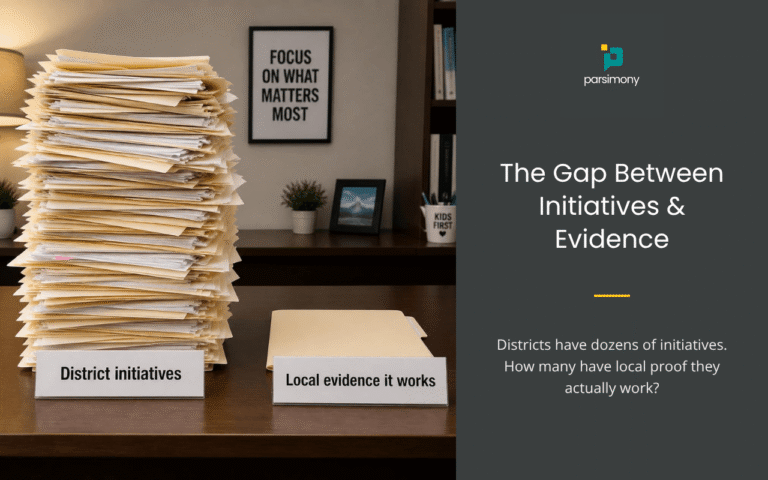

AI tools in schools are appearing across tutoring platforms, writing supports, learning apps, assessment tools, teacher dashboards, and products that districts already use. For district leaders, that creates a difficult question: how do you know whether AI is actually helping students?
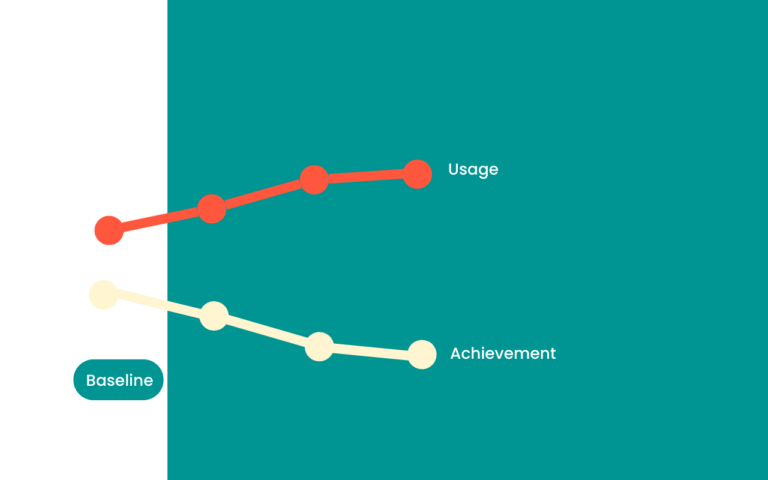
Adoption is easy to see. Usage dashboards can show logins, prompts, completed assignments, minutes on the platform, or teacher participation. But usage is not the same as impact. A student can use an AI tool every day and still become less confident, less engaged, or less able to think through challenging work without support.
That is why districts need to move from adoption to evidence.
The Evidence Behind AI in Education

The current research evidence around AI in education is mixed. Some coverage points to the promise of AI-enhanced tutoring, especially when tools are designed to support access, feedback, and personalized instruction. Stanford SCALE has highlighted AI-enhanced tutoring as one possible way to support more accessible and equitable learning, while also noting that equitable access remains a serious challenge.
But concerns are growing. Education Week reported that the use of AI can weaken relationships with teachers, citing a Center for Democracy and Technology report. USC Today reported that many students use tools like ChatGPT for quick answers rather than deeper learning unless educators actively guide them toward more thoughtful use. The U.S. Department of Education has also warned that AI systems can widen achievement gaps.
AI may become one of the most useful instructional supports districts have ever seen, but it could also become one of the most expensive shortcuts they have ever bought. The difference lies in the evidence.
Usage Metrics Cannot Answer the Most Important Question
For many EdTech products, usage data becomes the first proof point. That makes sense at the implementation stage. If no one is using a tool, it probably cannot help students.
But once an AI tool is being used, district leaders need to ask a different question. Not “Did students use it?” but “Did students benefit from it?”
Usage metrics can show activity, but they do not show whether learning improved. They do not show whether students developed stronger skills, attended school more consistently, performed better on assessments, completed more coursework, or showed fewer behavior concerns.
They also do not show whether the tool helped every student equally.
This is where EdTech usage vs outcome data becomes critical. A platform dashboard may show that a tool is popular. It may even show that students completed more practice or asked more questions. But if the district’s actual student outcome metrics do not move (or worse, decline), the tool may be creating activity without meaningful academic return.
For districts trying to understand how to measure EdTech effectiveness, the answer has to go beyond product engagement to connect AI use to outcomes the district already cares about.
The Real Question Is Whether Similar Students Did Better

In education, students may improve for many reasons. A new curriculum, a stronger teacher, schedule changes, family support, test familiarity, or tutoring can all affect results. But did students who used the AI tool outperform similar students who did not?
That is where EdTech impact evaluation becomes useful. Districts can use existing district data, including grades, benchmark assessments, standardized assessments, attendance, behavior, course completion, or other student outcome metrics, to compare students who used an AI tool with similar students who did not.
This does not require districts to stop everything for a large randomized controlled trial. In many school systems, random assignment is not practical. Students are already using tools. Teachers are already making instructional decisions. Products are already embedded in classrooms.
But districts can still use education impact evaluation methods that reflect real-world conditions. Matched comparison approaches, often used when random assignment is not feasible, help compare participating students to similar non-participating students. The Institute of Education Sciences (IES) has discussed matched comparison methods as a practical approach when evaluating program effects in real education settings.
That kind of analysis gives leaders something much more useful than a usage report. It helps them estimate whether the AI tool is associated with stronger outcomes than students would reasonably have achieved without it.
AI Evaluation Should Look at Equity, Not Just Averages
An AI tool might show positive overall results while mostly benefiting students who were already performing well. It might help students with strong home internet access more than students with limited access. It might work better in schools with stronger implementation support. It might help some grade levels while doing little for others.
That is why AI evaluation should include achievement gaps from the start.
District leaders need to know whether AI tools are helping close gaps or making them more pronounced. Are students who started below grade level catching up? Are English learners benefiting? Are students with inconsistent attendance seeing measurable gains? Are outcomes different by school, grade level, baseline achievement, or student group?
This is about making sure the district does not mistake an average result for an equitable one. If AI is going to be part of instruction, intervention, tutoring, writing, feedback, and student support, then districts need evidence that shows who is benefiting and who may be left behind.
Rapid-Cycle Evaluation Fits the Speed of AI Adoption
AI tools change quickly. Features are added, large language models are updated, and vendors adjust product claims. A traditional evaluation process that takes two years may arrive after the product has already changed, the contract has renewed, or the budget decision has passed.
That does not mean districts should accept weak evidence. It means the evaluation timeline has to match the decision timeline.
Rapid-cycle evaluation gives districts a practical way to evaluate AI tools while decisions are still active. Instead of waiting years for perfect evidence, leaders can use existing district data to get timely, rigorous insight into whether students using a tool are outperforming similar students who are not.
The gold standard is not always the study that arrives long after the decision. Sometimes, the gold standard is the evidence that helps district leaders make the right call when renewal, expansion, or budget review is happening now.
That is especially important for independent EdTech evaluation. AI vendors may have strong internal data, but districts need evidence they can trust, explain, and defend. Independent analysis helps move the conversation from “the vendor says this works” to “here is what happened with our students.”
What District Leaders Should Measure Before Renewing or Expanding AI Tools
Before renewing or expanding AI tools in schools, district leaders should ask:
- Are students using the AI tool outperforming similar non-users?
- Are results stronger for some student groups than others?
- Is the tool helping close achievement gaps or widening them?
- Are gains visible in district-priority outcomes?
- Are the results strong enough to justify renewal or expansion?
- Is the evidence independent enough to stand up in a boardroom?
These questions help shift AI decisions away from hype and toward evidence-based decision-making in schools.
Districts do not need to be anti-AI or blindly pro-AI. They need to be clear-eyed. Some tools may deserve expansion. Some may need better implementation. Some may not be worth the investment. The only way to know is to evaluate impact rather than adopt alone.