
Across Minneapolis and Hopkins, youth-serving nonprofits are doing some of the most important work in their communities.
Some organizations help students improve literacy skills after school. Others provide mentoring, STEM enrichment, attendance support, college readiness programming, arts education, or tutoring. Many of these programs operate with small teams, limited budgets, and an enormous amount of heart.
The challenge is that doing meaningful work is no longer enough on its own.
Funders, district partners, and nonprofit boards increasingly want evidence that programs are producing measurable impact. But participation numbers and internal surveys are often no longer enough to secure major grants or long-term partnerships.
For many Minneapolis nonprofits and Hopkins nonprofits, this creates a frustrating tension. They need stronger evidence, but traditional nonprofit program evaluation services often feel out of reach.
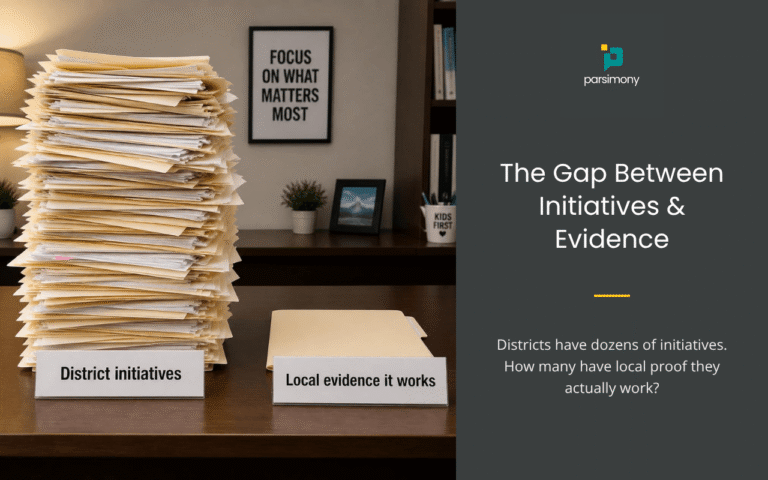
That is where many organizations fall into what could be called the “evaluation trap”: they know evidence matters, but the traditional path to obtaining it can feel too slow, too expensive, and too disruptive to pursue realistically.
What Traditional Evaluation Gets Right
Large-scale studies can be rigorous, highly customized, and deeply informative. In some situations, especially for statewide initiatives or long-term policy interventions, a multi-year evaluation may be entirely appropriate.
Traditional evaluations are like full medical exams, providing deep insight into long-term outcomes. The issue is that not every nonprofit decision requires that level of time, cost, or operational disruption.
A local literacy program refining implementation before next semester often cannot wait two years for answers. A nonprofit preparing a grant proposal for a Minneapolis foundation may need evidence during the current funding cycle, not after the students in the original cohort have already moved on.
That is why many organizations are now looking for more practical methods to evaluate their impact on educational outcomes while maintaining credibility and rigor. The goal is to provide a middle ground between “no evidence” and a massive academic research project.
What Traditional Evaluation Gets Wrong for Local Nonprofits

By the time many long-form studies are completed, programs, staffing, student populations, and funding priorities may have changed significantly. A study that validates your impact two years too late may still be rigorous, but it is not always useful.
Many nonprofits simply cannot justify redirecting large portions of their budgets away from direct student services and toward a six-figure evaluation process. Every dollar spent on evaluation is a dollar not spent on student services.
Staff members in local nonprofits are often already stretched thin. Additional assessments and reporting requirements can create serious evaluation fatigue.
This is one reason low-burden program evaluation models are becoming increasingly important. Organizations need evidence systems that support the mission rather than overwhelm it.
The Snapshot Report as a GPS for Student Impact

MomentMN Snapshot Reports are designed to function differently from traditional evaluation systems. These reports operate more like a GPS than a post-trip map.
They help nonprofits understand whether they are moving in the right direction before the next funding cycle begins.
Using existing district data, Parsimony compares students participating in a nonprofit’s program with similar students who did not participate. The goal is to estimate whether the program is associated with measurable lift on important student outcomes, compared to the status quo.
Those outcomes may include:
- Literacy growth
- Math performance
- Attendance trends
- Behavioral outcomes
- District benchmark assessments
- State assessment performance
- Academic growth indicators
Instead of waiting years for findings, organizations can receive actionable information while the program is still actively operating.
Why Local Data Matters
National research can absolutely be helpful. But local nonprofits often need answers tied directly to their own communities, schools, and student populations.
A mentoring program that works well in one district may produce different results elsewhere because implementation conditions and district priorities differ.
Organizations in Minneapolis and Hopkins often need to answer questions like:
- Is the program working for students in this specific district?
- Which student groups appear to benefit the most?
- Are results stronger in certain grade levels or school sites?
- Does the implementation align with district priorities?
- What adjustments should happen before the next grant cycle?
They are operational questions tied directly to funding decisions, partnership renewals, staffing strategies, and program expansion.
Strong student outcome metrics and thoughtful interpretation helps nonprofits move beyond assumptions and toward more informed decision-making.
Clarity Instead of a Pass/Fail Judgment
One reason many nonprofits hesitate to pursue evaluation is fear. Organizations worry that anything less than perfect findings will damage credibility or threaten funding.
But good evaluation should not function like a pass/fail judgment. It should function like a diagnostic tool.
Strong findings can absolutely support:
- Grant applications
- Donor conversations
- District partnership renewals
- Board reporting
- Case studies
- Nonprofit annual impact reports
Sometimes the data reveals opportunities for:
- Better student targeting
- Improved attendance consistency
- Adjustments to program dosage
- Stronger implementation quality
- Better alignment with district goals
Truth is ultimately more useful than polished claims that sophisticated funders may not fully trust.
Organizations that embrace honest evidence often achieve stronger long-term growth by refining programs rather than defending assumptions.
Who This Is For and Who It May Not Fit Yet
MomentMN Snapshot Reports are not designed for every possible nonprofit model, and being transparent about that matters.
Right now, this approach is best suited for organizations working with students in districts where relevant district data can be accessed and where outcomes connect to academic or school-based indicators.
Good-fit programs may include:
- Literacy support
- Math intervention
- Tutoring
- Academic mentoring
- Attendance-focused initiatives
- College readiness programming
- STEM enrichment
- Academic coaching
Programs focused exclusively on non-academic outcomes without district-linked indicators may not be the best fit for this type of evaluation.
Similarly, nonprofits operating in districts without existing data partnerships may require additional setup before this model becomes feasible.
That said, the network continues to grow. Organizations in neighboring districts are encouraged to reach out as additional partnerships and K–12 impact evaluation services expand.
Escape the Evaluation Trap
Minneapolis and Hopkins nonprofits should not have to choose between serving students and proving impact. Organizations deserve evaluation systems that move at the speed of real educational work.
With a rapid-cycle, low-burden approach, nonprofits can access credible evidence while staying focused on students and communities. For many organizations, the process feels less like being judged and more like having a navigator in the passenger seat helping interpret the road ahead.
To experience what it is like to receive a MomentMN Snapshot Report describing the impact of a program on students in a school district, click here and complete the form to request a sample Snapshot Report.