
For many district leaders, budget season has become an exercise in impossible choices.
Federal pandemic relief funding has expired. Enrollment shifts continue to affect revenue projections. State funding priorities evolve. Operational costs rise. Staffing pressures remain.
At the same time, expectations for student outcomes have not decreased.
Superintendents, Chief Academic Officers, and Chief Financial Officers are still expected to improve achievement, close learning gaps, support attendance, strengthen student engagement, and demonstrate responsible stewardship of public resources.
The challenge is that districts can no longer afford to fund everything.
Every budget cycle eventually forces difficult questions. Which programs should stay? Which should expand? Which should be redesigned? And perhaps most importantly, which initiatives should end?
The wrong answer can have lasting consequences for students, educators, and communities.
That is why program evaluation for school districts is becoming increasingly important. When resources are limited, districts need more than opinions, assumptions, or vendor promises. They need objective evidence that helps identify which investments are truly moving the needle for students.
The Reality of Modern Budget Pressure
District leaders often find themselves squeezed from both sides. On one side are growing fiscal pressures. On the other are legitimate demands to improve student outcomes. Neither pressure is going away.
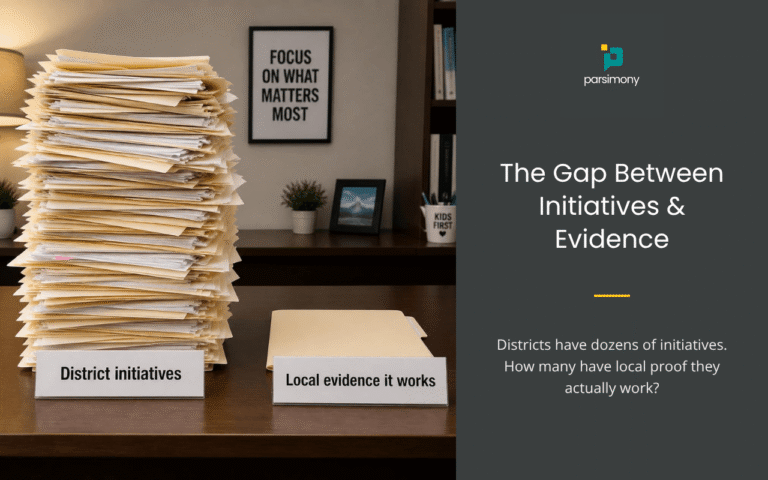
Many districts have accumulated years of programs, services, and interventions. Over time, budgets become crowded, leaving leaders asking a simple question: What is actually working?
Many districts have access to plenty of data, but very little clarity. This is one reason education program evaluation has become a critical leadership function rather than simply a research exercise.
The goal is not to collect more information. The goal is to make better decisions.
The “Nice-to-Have” Illusion
When districts face financial pressure, budget decisions are often influenced by factors that have little connection to actual student impact.
Some programs have vocal champions. Others benefit from institutional momentum. Some have been around for years and feel familiar. Others generate impressive-looking dashboards filled with usage statistics.
These factors can create what might be called the “nice-to-have” illusion.
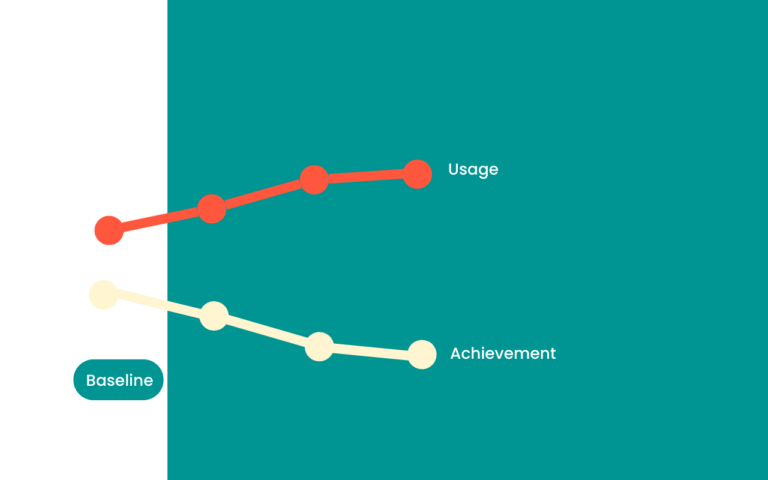
A product may appear successful because students logged in frequently. A service may appear valuable because participation rates are high. A platform may look impressive because dashboards show thousands of minutes of usage.
But usage is not impact. Logins are not outcomes. Minutes spent in a program do not automatically translate into academic growth. Yet many purchasing and renewal decisions continue to rely heavily on activity metrics because they are readily available.
Unfortunately, activity metrics often fail to answer the most important question. Did students actually benefit?
Usage data rarely tells the full story. Without objective evaluation, districts can mistake activity for impact and overlook programs that are quietly producing meaningful results.
The result is often uncertainty. That uncertainty becomes particularly costly during budget reductions.
Without independent program evaluation services, districts may find themselves making high-stakes decisions based on assumptions rather than evidence. That creates risk for both student outcomes and public trust.
Why Objective Evidence Matters
This is where evidence-based decision-making in schools becomes essential.
When districts connect spending to measurable outcomes, conversations shift from anecdotes to evidence and from assumptions to results. This is particularly important when evaluating large portfolios of educational products and services. Districts rarely need more opinions.
They need a reliable way to determine which investments are generating measurable returns and which are not.
The Snapshot Report: An Objective Referee

Parsimony’s MomentMN Snapshot Reports are designed specifically for this challenge.
Instead of functioning as another lengthy research project, Snapshot Reports provide a rapid-cycle evaluation that helps districts understand which programs are associated with positive student outcomes.
The process is intentionally low burden. Instead of collecting new surveys, administering additional assessments, or disrupting instructional time, Parsimony uses existing district data.
- Attendance records.
- Assessment results.
- Behavior indicators.
- Academic performance measures.
- Other student outcome metrics already collected by the district.
Using a rigorous matching methodology, students who participated in a program are compared to similar students who did not participate.
The goal is to estimate whether meaningful differences appear between those groups, resulting in an independent program evaluation focused on outcomes that matter.
District leaders receive practical evidence tied directly to district priorities and key performance indicators because every finding improves decision quality.
Building a Bulletproof Budget Portfolio
When leaders can demonstrate that investments are connected to measurable student outcomes, they gain confidence in difficult decisions. They can explain renewals with evidence. They can justify the expansion of successful initiatives.
Most importantly, they can confidently say no to low-impact programs.
That matters because every dollar protected from ineffective spending becomes available for higher-impact work. In many districts, the challenge is not a lack of commitment. It is a lack of clarity.
Instead of asking which programs are most popular, districts can ask which programs are most effective.
Instead of defending historical decisions, leaders can focus on future outcomes.
Instead of cutting blindly, they can cut strategically.
Protecting Students Through Better Decisions

Budget reductions are never easy. No superintendent enjoys eliminating programs. No CFO wants to reduce resources. No academic leader wants to tell staff that difficult choices must be made.
But avoiding decisions is not a strategy. Making informed decisions is.
The districts that navigate financial pressure most successfully are often the ones that embrace objective evidence early. Effective program evaluation for school districts is not about proving every initiative works. Strong program evaluation budgeting is about understanding which investments deserve protection.
When resources become constrained, clarity becomes one of the most valuable assets a district can possess. After all, the goal is to preserve and strengthen what works.
That is how districts protect student growth, maintain public trust, and build sustainable long-term strategies.
Parsimony’s MomentMN Snapshot Reports help district leaders transform existing data into independent, actionable evidence that supports smarter budget decisions.
Don’t trim your budget blindly. Contact Parsimony today for a free diagnostic consultation and discover how your existing district data can become an evidence-based shield for student growth.